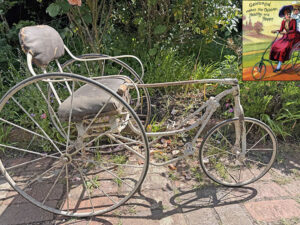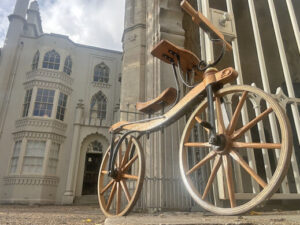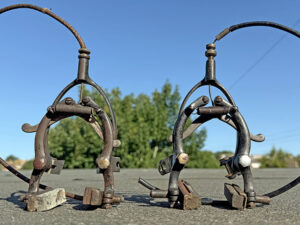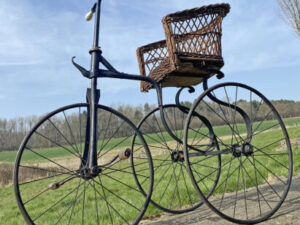


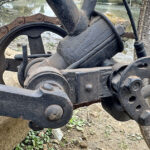


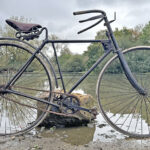


I bought this odd contraption from The Science Museum. According to their records, item no 1968-570 was acquired in 1968 from the Surrey branch of the Cyclists’ Touring Club. They didn’t know what it was, but closer inspection reveals it to be a patent model for a rear brake. The frame appears to be that of a Marriott & Cooper Humber, which has been adapted at the open steering joint and bottom bracket, using wood, to accept the rear brake apparatus. The wooden cylinder seems to have been used to support the bottom of the down tube and seat tube, as the bottom bracket has been moved to fit the brake mechanism. It has also had a small bridge fitted between the seat tube and the rear mudguard for additional support. Marriott & Cooper used a similar bridge on their ‘Model B’ of 1891.
To register a patent it was only required to illustrate how the invention would function, so wood was easier to use. Once a patent was registered it could be shown to any interested parties. That way an inventor did not need to go to the expense of building bicycles themself beyond an initial prototype.
This appears to be built up from scraps of available items, so it is most likely an amateur patent application. Cyclists in this era often made improvements to the bicycles they had bought, or followed through on various ideas they had while cycling. If their idea was novel – or if they adapted a previous invention but used it in a different way – they could register it as an ‘improvement in velocipede design’ and maybe earn some money (and prestige) if a manufacturer used the patent.
Nearly every part of a bicycle was covered by a patent, so when a company built a bicycle they needed to plan it carefully to calculate the cost in license duties, and to see what parts were not covered by a patent. For example, the open steering that you see on this bicycle was patent-free, which is why it was used by so many cycle companies even though the ‘ball head’ steering joint had already been invented. (William Bown was the primary patent-holder for ball bearing cups and he charged a fee for their use).
Humber showed a bicycle in 1889 with a rear brake, developed because it had a sprung front fork. But rear brakes were not in general use until after 1900 when the freewheel hub had been introduced and made them necessary. Before 1899 bicycles were fixed wheel so a plunger front brake was adequate. The plunger front brake was so common that I assume there was no patent applicable or that it was easy to make one that avoided other companies’ patents. The interesting thing about circumnavigating other companies’ patents was that once you had successfully done so your own design might qualify as an ‘improvement’ for patent registration.
None of this is 100% certain, but it offers a valid reason for the existence of this bicycle, and why it would have been donated to The Science Museum.
The bicycle itself is not rideable as the parts around the bottom bracket have been loosely assembled. The seat post is upside down, but I’ve left it like this because this is how it arrived from The Science Museum. I’ve only added an appropriate saddle top.
View in the Online Bicycle Museum
BICYCLE COLLECTORS CURATED ONLINE AUCTION, Spring 2026
This Timed Auction is live . Highest bid wins.
NO BUYERS or SELLERS PREMIUM.
THE RESERVE IS THE START PRICE + BUY-IT-NOW OPTION.
INTERNATIONAL DELIVERY: NO PACKING FEES.
BIDDING INCREMENTS: Up to £1000 = £10. Over £1000 = £50. Over £2000 = £100
IT’S A CURATED AUCTION – Colin is the auctioneer and is available to chat to you personally during the auction (or before) by email, text message, phone call, Facebook Messenger or WhatsApp.